
Tesla’s Driver-Assistance System Takes on Italy: Navigating Narrow Cobblestone Streets, Tricky Roundabouts, and More
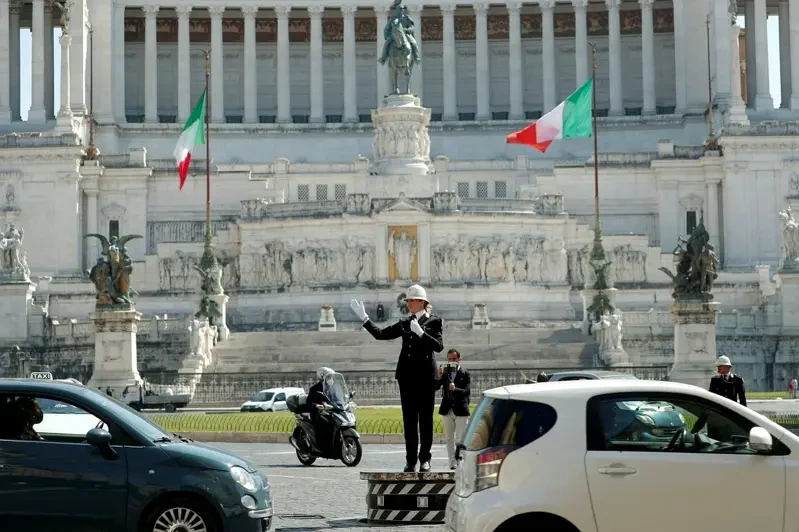
Italy has granted temporary approval for Tesla’s assisted driving system, demonstrating its capabilities through tests in the complex traffic conditions of Rome. However, online observers argue that the city’s narrow cobblestone streets, roundabouts, and chaotic traffic flow will pose a far more rigorous real-world test.
The Italian Ministry of Transport has officially authorized the use of Tesla’s assisted driving system, placing Italy ahead of Germany, France, and Spain in this regard. Yet, while officials remain optimistic, media outlets and internet users suggest that Italy’s chaotic urban traffic will subject this American-developed AI system to what could be described as the “toughest stress test on Earth.”
According to a report by the Central News Agency (CNA), citing a press release from the Italian Ministry of Transport, the country’s motor vehicle authority has issued a temporary permit to Tesla following a technical review. This makes Italy the 12th European Union nation to approve the system, joining countries such as the Netherlands, Denmark, Belgium, and Finland. Matteo Salvini, Italy’s Deputy Prime Minister and Minister of Transport, emphasized that this decision marks a significant step toward smart transportation for Italy, while underscoring that public safety remains the top priority.
To demonstrate the system’s capabilities, Tesla’s official European account released a test video on the social media platform X. The footage shows a Tesla navigating the complex traffic conditions of Rome’s historic city center and the area surrounding the Colosseum. Throughout the drive, the driver’s hands remain off the steering wheel, yet the vehicle successfully executes turns, changes lanes, and navigates through large roundabouts.
Although the footage released by the company suggests the system handles the environment with ease, the news sparked lively discussion—and a wave of dark humor—within Italian online communities. Given that traffic in Italy’s historic cities is notorious for its chaos, many netizens left comments joking: “If a Tesla can make it out of downtown Naples in one piece, Elon Musk should personally hand it a graduation diploma,” and “No matter how powerful the AI’s computing capacity is, can it figure out whether the Vespa ahead is about to overtake on the left or the right?”
Netizens point to four main reasons why driving in Italian city centers is considered the “ultimate boss level” for autonomous driving systems. First, there are the ancient landmarks and narrow cobblestone streets. In historic districts like those in Rome or Florence, streets were originally designed for horse-drawn carriages; they are extremely narrow, filled with blind corners, and paved with traditional basalt cobblestones (sanpietrini). This uneven surface poses a significant challenge to the stability of onboard cameras and sensors.
Next, there are the surreal, multi-lane roundabouts that lack clear road markings. Italy has a vast number of roundabouts, and in many cases, the pavement markings have faded or worn away due to a lack of maintenance. Local drivers have long navigated these circles by relying on a combination of “unspoken understanding,” the use of their horns, and eye contact. This system—an informal set of rules heavily dependent on human intuition—poses a significant challenge for algorithms designed around standardized logic.
Third, there is the omnipresent flow of two-wheeled vehicles and compact cars. On Italian streets, scooters and small cars—such as Smart cars or Fiat 500s—routinely weave nimbly through gaps in traffic. Compounded by pedestrians who cross the road at will, the traffic conditions shift and evolve almost by the second. Furthermore, in some southern cities (like Naples), traffic signals and “yield” signs are sometimes treated as mere “suggestions.” Double-parking—or even triple-parking—is a common occurrence, forcing other vehicles to frequently cross double yellow lines to maneuver around the obstructions.
In response, the Italian Ministry of Transport has reiterated the regulatory bottom line in its authorization decree: even when driver-assistance systems are engaged, the human driver remains fully responsible for safety. Drivers must keep their hands on the steering wheel at all times, remain focused, and be prepared to intervene and take control of the vehicle instantly. The world is watching to see who will emerge victorious in this head-to-head clash between “cutting-edge AI from Silicon Valley” and the “laid-back, improvisational Italian driving philosophy.”
Skyscraper in Saudi Capital Struck Again; 11 Injured; Coalition Condemns Terrorist Attack